
Community First News & Updates
Wiltshire Village Halls – Impact of Energy Costs Survey
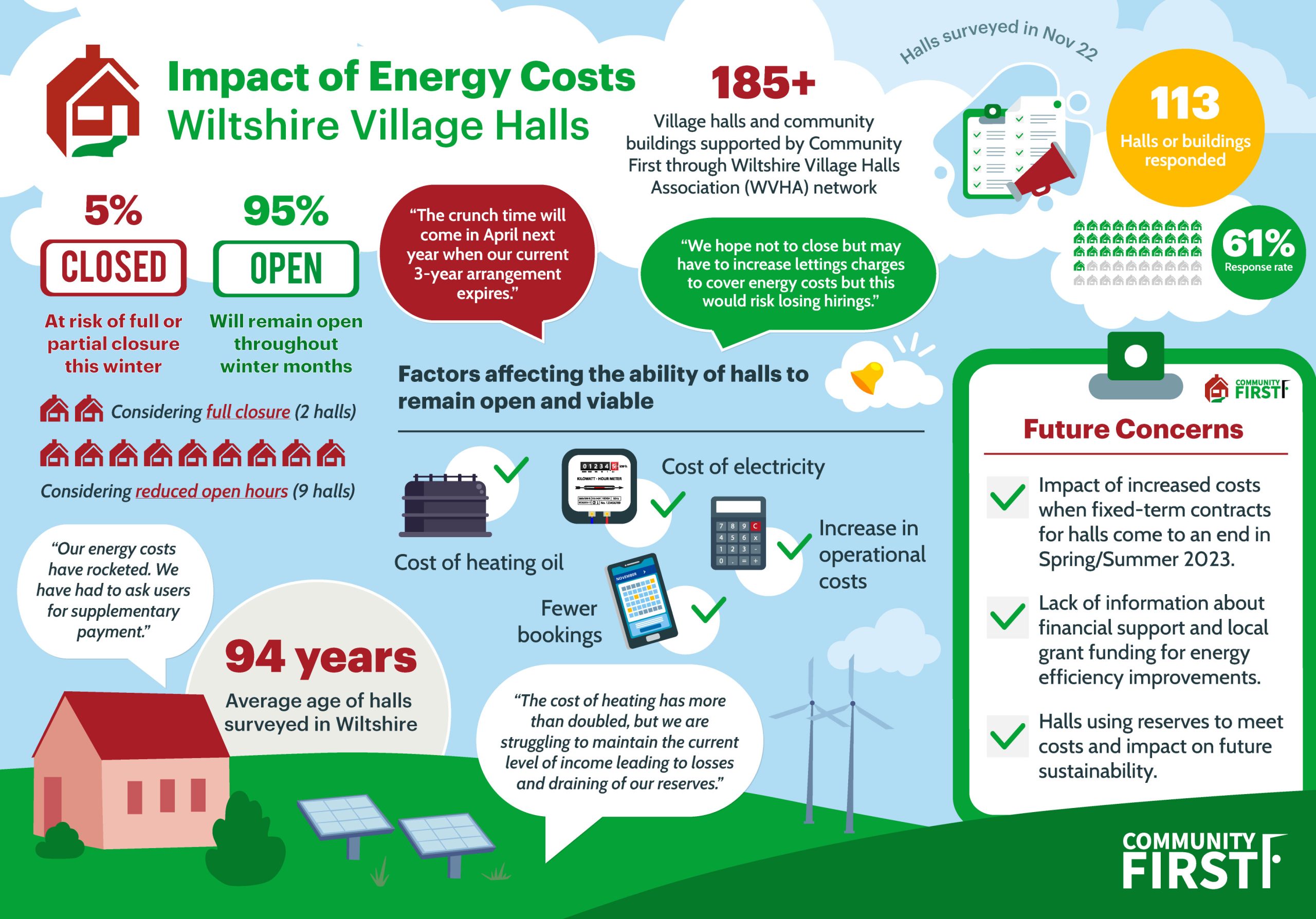
Community First surveyed village halls and community buildings in membership of Wiltshire Village Halls Association (WVHA) in November 2022. The aim of the survey was to understand the impact of energy costs on WVHA members across the county and any potential impact this might have for the community. A total of 113 halls or buildings responded to the survey, which represents 61% of WVHA members.
The survey was created using Microsoft Forms and contained 8 questions in total, with a mixture of closed and open responses. The survey called ‘Impact of Energy Costs on Wiltshire’s Village Halls’ was shared with hall members via email, with a link to complete the survey online. A summary of findings from the survey is included below including a selection of verbatim responses from halls and buildings. All responses have been anonymised.
Hall Opening Hours and Availability
Wiltshire village halls and community buildings remain resilient, despite increased energy costs and wider cost of living pressures. Despite this, there are future challenges ahead with fixed-term energy deals coming to an end and halls who are currently dipping into their reserves to stay afloat.
95% of halls and buildings intend to stay open throughout the winter, with just 5% of halls considering a full or partial closure. Of halls/buildings suggesting they are considering closure this winter, 2 halls said they may close completely and a further 9 halls are considering reduced opening hours.
The primary motivation behind potential hall closures or reduced open hours is the cost of heating the hall including the cost of oil, electricity costs and other operating costs. 3 halls who responded to the survey (3%) said their hall or building was at permanent risk of closure.
Warm Space Provision
Village halls and community buildings are a vital local meeting place for communities, offering a warm and welcoming space for group activities, sports, lunch clubs and other social events. With the increase in energy costs, many local authorities and charities across the country have begun putting together lists of ‘Warm Spaces’ for people who are unable to afford to heat their homes.
The majority of halls (56%) who responded to the survey did not intend to provide a Warm Space for the community this winter. Whilst some halls indicated that the cost of heating was a factor in decisions about providing a Warm Space for the community, other halls said bookings from regular hall users prevented them from offering a Warm Space.
37% of halls and buildings (42) suggested they were considering offering a Warm Space. A total of 8 halls or buildings (7%) intended to provide a Warm Space for the community this winter.
Age of Halls and Buildings
Overall the average age of halls who responded to our survey was 94 years. With some halls hundreds of years old and other halls or building which are very modern. The age of village halls and community buildings in Wiltshire is a factor which impacts the ability of some halls to limit the rising cost of energy. Some halls have older heating systems which are costly to run or lack insulation.
“As it’s an old, corrugated building it has no insulation at all.”
“The Church is using the Parish Hall to provide a warm space once a week until the end of March. The cost of just heating our small hall for this 3-hour session is £20 as we have antiquated infrared wall heaters! The cost of electricity in particular (as well as increases to our other overheads) is a major concern.”
With the rising cost of energy and other operational costs, some halls are unable to afford to make energy efficiency improvements.
“We are concerned about energy costs. Insulation etc is needed but grants do not seem readily available in Wiltshire.”
Impact on Halls
All respondents were invited to leave a general comment on energy costs as they relate to village halls and community buildings. Several of the halls who responded to our survey said they were on a fixed rate tariff for energy so had not felt the impact of rising costs (so far). The majority of halls who said they were on a fixed contract for energy, suggested their fixed deal would come to an end in 2023. This suggests that other halls and buildings may be vulnerable to closure or reduced opening hours next year.
“We are fortunate in still being on a fixed electricity contract until June 2023, so until then, will not be adversely effected by the recent hike in electricity prices.”
“We have a fixed rate electric contract until 31 March 2023 so not affected by increased charges until then.”
“The crunch time will come in April next year when our current 3-year arrangement expires.”
Some halls and buildings plan to make energy efficiency improvements including improved insulation, new doors and windows, solar panels and digital solutions to control the temperature in the hall/building remotely.
“We have an energy deal running until Sept 23 so are very fortunate. We are considering solar panels and battery to reduce the electricity costs.”
“Roof to main hall is being insulated to reduce heat loss.”
Some halls and buildings said they have increased their hire charges to help offset the rising cost of energy and other operational costs. These halls are having to make careful decisions about how much to charge, both to cover their own costs and also to avoid losing regular hirers with increases in hire charges. This is likely to have a knock-on effect on smaller groups and organisations who use village halls and community buildings for their activities.
Other halls are charging (or considering charging) an additional fee or levy for heating costs, including coin operated heating.
“We hope not to close but may have to increase lettings charges to cover energy costs but this would risk losing hirings.”
“We are monitoring energy costs almost daily and have, as expected, already seen them increase. We will probably have to introduce a supplemental charge for increased energy costs during the colder months.”
“Our energy costs have rocketed. We have had to ask users for supplementary payment.”
Several respondent halls suggested there was a lack of financial support to help halls/buildings and organisations mitigate the impact of rising energy prices. This includes grants and support to make older halls and buildings more energy efficient. Indeed several halls and buildings are dipping into reserves to make energy payments and meet operational costs, this is a potential risk to the long-term sustainability of village halls which could make them vulnerable to closure in the future.
“The Hall committee is fortunate as we have reserve funds but we didn’t really expect to have to use them to pay energy costs.”
“The cost of heating has more than doubled, but we are struggling to maintain the current level of income leading to losses and draining of our reserves.”
What Happens Next?
Community First will share the findings from the survey with ACRE and other partners to raise awareness of the issues impacting village halls and community buildings in Wiltshire, as they relate to energy prices. We will continue to monitor the impact of energy prices on halls locally, particularly as we move through Spring/Summer 2023 when many halls told us their fixed energy price deals come to an end.
We are aiming to gather additional resources and reach out for support to assist halls with information relating to energy efficiency improvements and will keep halls and buildings up to date with the latest information about support offered from Government as it becomes available.
We have also summarised the findings from the survey in an infographic which you can view by clicking the image below.
Support Us
Support our work and your local community
Membership
Become a member and get regular updates including funding news.
Contact Us
Contact details for the Community First team.